By Amos Thembo
The ubiquitous hunger in the Rwenzori and Karamoja regions is greatly attributed to perennial climate change effects on our communities. Climate change has led to poor agricultural practices and natural disasters that have vastly resulted into low food production thus hunger. According to the UBOS report of July 2021, hunger greatly hit these regions because of disasters and limited efforts to promote food security like supporting majority vulnerable farmers with healthy seeds, teaching farmers good farming methods and supporting all projects that aim to increase food systems. Food is a fundamental right to everyone that needs to be promoted at all costs. The Rural communities are a hub for food basket but little has been done to aggrandize the efforts towards sustainable agriculture and food security.
According to United Nations, food security is attained when all people, at all times, have physical, social and economic access to sufficient, safe and nutritious food that meets their food preferences and dietary needs for an active and healthy life. However this is still a very big challenge in the wake of disasters and Covid 19 in Rwenzori and Karamoja regions.
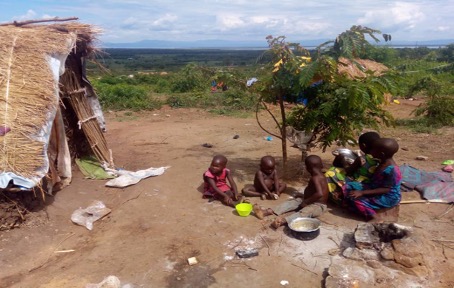
The presence of natural disasters has continuously bred hunger thus malnutrition among the children. It is observed that Malnutrition cases have increased among children living at flood emergency camps in Kasese district and Rwenzori at large. This condition has been due to poor dietary quantity and quality with only less than 2 in 10 children consuming a minimum acceptable diet, poor feeding and caring practices as a result of high mother workload, low water use where only about 30% of the households meet the recommended water use per person every day, presence of diseases like Malaria that stand at 18% and diarrhea at 15% in Karamoja region. It is important to note that increasing number of cases of anemia among children in these regions is associated with poor feeding styles.
A Picture showing children at Kahokya emergency camp that were displaced by May 2021 torrential floods in Kasese District
In this regard, there is need to Integrate WASH (Water Sanitation and Hygiene) in nutrition and health education at health facilities and during outreaches to communities. This will create awareness among families living in rural areas. Some communities still believe in myths about nutritious foods thus the need to dispel such and all misconception about food taboos for good nutrition. This can be achieved through broadcasting the message about nutrition on radios in local languages, in church, mosques, and at social gatherings by local leaders.
There is need to introduce routine community based micronutrient powder provision through the village Health Teams and Strategies (VHTs). There is need to Prioritize universal treatment of all children with acute malnutrition conditions because their parents and caregivers are not in position to afford the cost of treatment thus subjecting them to death. There is need to improve the spread of information about child care in the rural communities. Cognizant of the fact that some mothers and caregivers go to bars to drink alcohol, little time is given to their children thus malnutrition condition among the children.